
Are better times ahead for people with executions?
Unlock your access to EDUtéka
Already have an account? Log in
Selected for you

Brain&Breakfast · May 23, 2019
Czechia, a debt enforcement paradise. Or not?
Happiness@Work Live! · October 30, 2025
Ján Košturiak: The last will be first

Happiness@Work Live! · October 29, 2025
Christina Glavas: beyond happiness – how to develop well-being at work

Happiness@Work Live! · October 28, 2025
Dita Formánková: The role of a leader in the age of AI

Happiness@Work Live! · October 27, 2025
Lukáš Bakoš: Should we learn from machines?
Changes to the enforcement code come into effect in January 2022. After 20 years, the law has been amended to ease the system of unenforceable executions and establish more effective and fairer rules for both debtors and creditors.
For example, the logic of debt repayment will be reversed — money will first go towards reducing the principal (original debt) and then cover the accessories (interest, fines, penalties, fees, etc.), which can account for up to 80% of the total debt. The psychological pressure from bailiffs related to so-called movable property executions — seizing household items — will also be limited.
Why watch the episode?
- What exactly has changed for people in execution? How they now have a better chance at a fresh start.
- What potential changes have occurred for you as an employer.
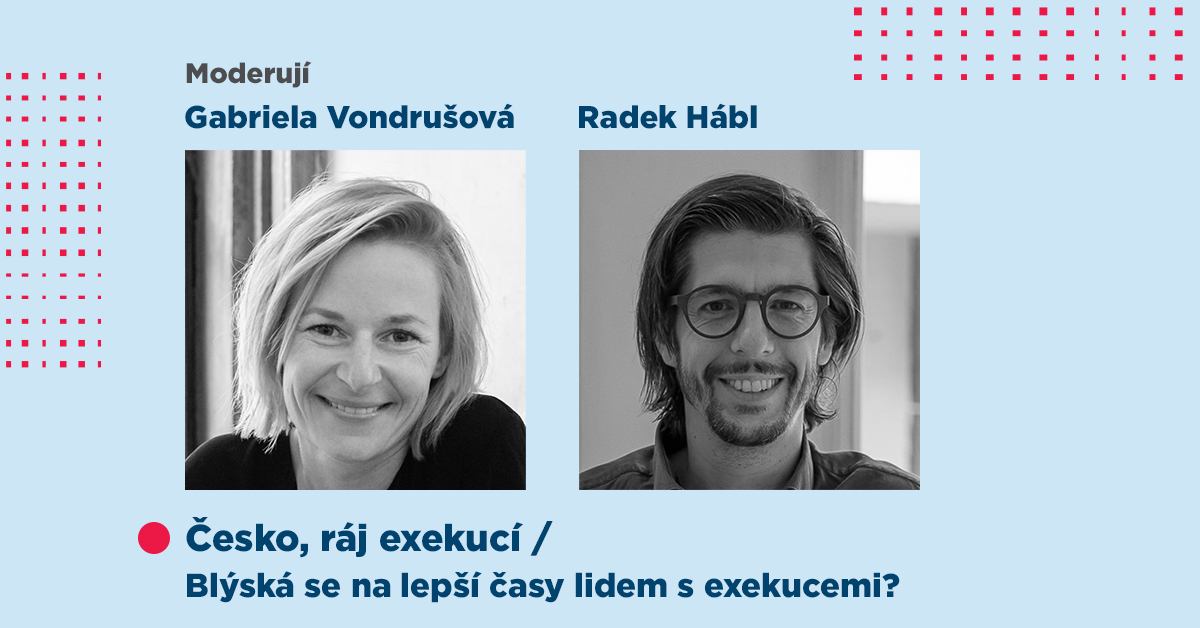
Who are the moderators
Gabriela Vondrušová
Gabriela Vondrušová currently works at the Institute for Prevention and Resolution of Overindebtedness on systemic changes in the area of debt and executions. She is heavily involved in the development of the anti-execution program in companies — helping them become more productive. She has always enjoyed connecting business with (nonprofit) projects that improve the world around us. That’s why in recent years she worked with the international organization Ashoka, which seeks and supports social innovators, and contributed to the development of sustainable tiny housing concepts and the creation of a coworking-community center from a former brownfield outside Prague.
Radek Hábl
Radek Hábl graduated from the University of Economics in Prague and spent 12 years in various financial roles in the private sector. In 2014, he moved into the nonprofit sector and three years later launched the unique project Mapa exekucí, a tool that brings execution data to the local level. Two years ago, together with colleagues, he founded the Institute for Prevention and Resolution of Overindebtedness, which focuses on household debt, executions, and insolvencies and strives for systemic changes in this area. He also raises awareness on this topic through his Twitter profile. Since 2018, he has been a member of the Ashoka Fellow network and since 2020 has served on the Government Council for Human Rights.
Selected for you
Brain&Breakfast · May 23, 2019
Czechia, a debt enforcement paradise. Or not?
Happiness@Work Live! · October 30, 2025
Ján Košturiak: The last will be first
Happiness@Work Live! · October 29, 2025
Christina Glavas: beyond happiness – how to develop well-being at work
Happiness@Work Live! · October 28, 2025
Dita Formánková: The role of a leader in the age of AI
Happiness@Work Live! · October 27, 2025
Lukáš Bakoš: Should we learn from machines?